
Introduction
The Biggest Mistake Creators Make
The year is 2026, and the most expensive mistake you can make as a creator isn't a "bad" post or a typo in a caption—it’s saying, "What is your budget?" before you know your own value.
When you let a brand set the price, you aren't just leaving money on the table; you are essentially telling the market that your creativity is a commodity rather than a specialized service. In a world where AI can generate a thousand "perfect" images in seconds, your value lies in your unique human connection. If you don't price that connection correctly, you’re working for free.
Why Influencer Pricing is Confusing in 2026
We’ve moved past the "Wild West" days of influencer marketing, but 2026 has brought its own set of complications. Platforms have fragmented, "shadow-banning" fears fluctuate, and the rise of Synthetic Influence (AI creators) has forced human creators to prove their worth through deeper data. With varying metrics across TikTok, Instagram, and YouTube, a "one size fits all" price tag is a relic of the past.
What This Guide Will Solve
This isn't just a list of numbers. By the end of this guide, you will have:
Clear, data-backed formulas for 2026.
A breakdown of why your 10,000 followers might be worth more than someone else’s 100,000.
Negotiation scripts that actually work.
A framework to ensure you never undersell your art again.
What Is Sponsored Content Pricing?
Definition of Sponsored Posts and Brand Collaborations
At its core, sponsored content pricing is the fee a creator charges a brand to produce and distribute content that promotes a product or service. This isn't just "buying a post." It’s a package deal involving:
Creative Production: Your skills as a photographer, videographer, and editor.
Distribution: Access to your loyal, curated audience.
Endorsement: The "trust equity" you’ve built with your community.
How It Works in 2026
On Instagram, it’s about aesthetic and lifestyle integration. On TikTok, it’s about raw, high-energy entertainment and the "hook." On YouTube, it’s about deep-dive education and long-term searchability. Brands pay because "traditional" ads are increasingly ignored; creators provide a native, trusted experience that bypasses the "ad-blindness" of modern consumers.
Key Factors That Affect Influencer Pricing
Before we talk numbers, we have to talk variables. You aren't just a number; you’re a collection of data points.
Follower Count: The Tiers
While not the only factor, tiers help brands categorize their spend:
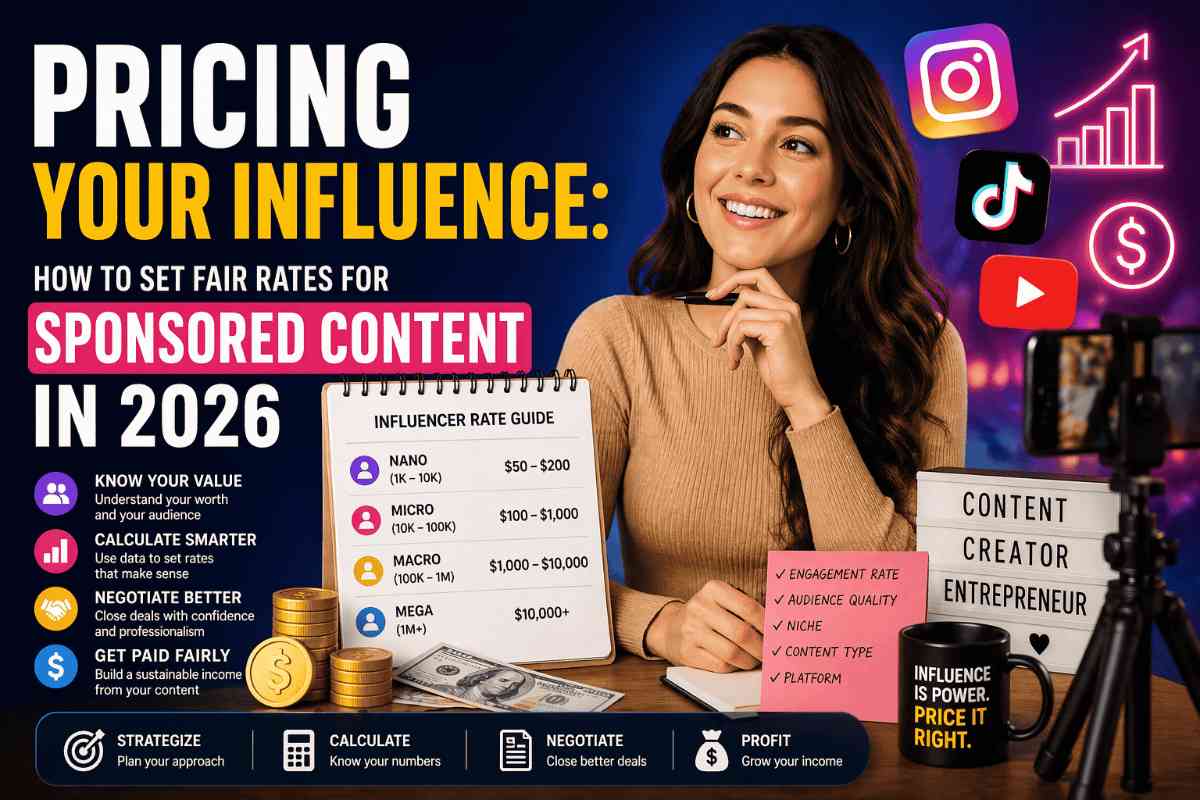
Nano Influencers (1k–10k): Hyper-local, ultra-high trust.
Micro Influencers (10k–100k): The "sweet spot" for ROI.
Macro Influencers (100k–1M): Massive reach, professional-grade production.
Mega Influencers (1M+): Celebrity-level status and broad brand awareness.
Engagement Rate (ER): The Metric That Matters
In 2026, a high follower count with low engagement is seen as a "dead" account. Brands want to see that people are actually talking back.
To calculate your Engagement Rate (ER), use this formula:
$$ER = \left( \frac{\text{Likes} + \text{Comments} + \text{Shares}}{\text{Total Followers}} \right) \times 100$$
Note: For Reels and TikToks, substitute "Total Followers" with "Average Views" for a more accurate representation of current reach.
Niche & Audience Quality
Not all followers are created equal. A follower in the Personal Finance or SaaS Tech niche is objectively worth more than a follower in a general Meme/Comedy niche because the "intent to buy" and the "Customer Lifetime Value" (CLV) in those industries are much higher.
Content Type & Production Effort
A 15-second "unboxing" Story takes 10 minutes to film. A 10-minute YouTube "Deep Dive" takes 20 hours to script, film, and edit. Your price must reflect the labor involved, not just the viewership.
Influencer Pricing Formulas (2026 Updated)
Use these as your baseline, then adjust based on the "Key Factors" above.
Formula 1: The Per 1,000 Followers Rule
This is the "old reliable" of the industry.
The Rate: $10–$20 per 1,000 followers.
Example: 50,000 followers = $500–$1,000 per post.
The Flaw: It ignores engagement. If you have 50k followers but only 100 people see your post, the brand is overpaying.
Formula 2: Engagement-Based Pricing
This is the gold standard for 2026.
The Rate: $0.15–$0.30 per average engagement (likes + comments).
Why it works: It rewards creators who actually move their audience to action.
Formula 3: The CPM Model (Brand Perspective)
Brands often compare you to traditional digital ads (Facebook/Google Ads). They look at CPM (Cost Per Mille/Thousand Impressions).
Formula: $\text{Price} = \left( \frac{\text{Average Expected Views}}{1000} \right) \times \text{Target CPM}$
In 2026, average creator CPMs range from $20 to $50 depending on the niche.
Real Pricing Examples (By Follower Count)
Tier | Follower Range | Est. Rate (Single Post/Video) | Best Revenue Strategy |
Nano | 1k – 10k | $50 – $250 | High-quality UGC (User Generated Content) |
Micro | 10k – 100k | $250 – $1,500 | Multi-platform bundles |
Macro | 100k – 1M | $1,500 – $10,000 | Long-term ambassadorships |
Mega | 1M+ | $10,000+ | Equity deals & Licensing |
Platform-Specific Pricing Guide
Instagram Sponsored Post Rates
Instagram is now a "portfolio" platform.
Reels: Command the highest price due to virality potential.
Stories: Usually priced at 30% of a Reel's price.
Carousels: Great for educational content; priced slightly higher than a single image.
TikTok Influencer Rates
TikTok is the "Wild West" of 2026. Rates are often lower per follower but higher per view. Brands pay for the creative concept. If you are a "trend-starter," you can double your rates.
YouTube Sponsorship Rates
YouTube remains the highest-paying platform. Why? Longevity. A YouTube video is a searchable asset that provides value for years.
Standard Integration (60-90 seconds): Based on average views over 30 days.
Dedicated Video: Usually 2x–3x the price of an integration.
How to Calculate Your Exact Rate (Step-by-Step)
Step 1: Calculate your average reach. Don't look at your "best" post. Look at the average of your last 10 posts.
Step 2: Apply the Formula. Use a blend of the CPM model ($30 CPM) and the Engagement model ($0.20 per engagement).
Step 3: Add the "Niche Premium." If you are in finance, tech, or luxury, add 20–50%.
Step 4: Factor in Usage Rights. Are they using your video for an ad? Add a Usage Fee (typically 20-50% of the base fee per month of use).
Pro Tip: Keep a "Rate Card" PDF ready, but always frame it as "Starting at..." to give yourself room to negotiate based on the brand's specific needs.
How to Negotiate Brand Deals Like a Pro
The "No Budget" Trap
When a brand says, "We don't have a budget for this, but we offer great exposure," remember: Exposure doesn't pay for your internet bill.
Your Response: "I’m so glad you see the value in my audience! Since I have a limited number of partnership slots per month, I prioritize paid collaborations to ensure the highest production quality. I’d love to revisit this when a budget is allocated."
Negotiation Scripts
Scenario: The Lowball Offer.
Creator: "Thank you for the offer! Given the production time for a high-quality Reel and the current engagement rate of 5%, my standard rate for this deliverable is [Your Price]. I can, however, offer a discount if we bundle this into a three-month campaign."
Scenario: Responding to "What’s your rate?"
Creator: "To give you an accurate quote, could you let me know the intended usage (organic only or paid ads?) and the timeline for the deliverables?"
What to Include in Sponsored Content Contracts
Never start work without a signed contract. In 2026, these four pillars are essential:
Deliverables: Exactly how many posts, what format, and which platforms?
Exclusivity: Can you work with their competitors? If they want exclusivity, charge extra (it’s an opportunity cost).
Usage Rights: How long can they use your face in their ads? 30 days? 6 months? Forever? (Never give "Forever" for free).
Payment Terms: Net-30 is standard. Ask for 50% upfront if the project is large.
Legal & Disclosure Guidelines
The FTC (Federal Trade Commission) isn't playing around in 2026.
The Rule: Disclosures must be "clear and conspicuous."
How to do it: Use
#ador#sponsoredat the beginning of the caption or as a clear text overlay in videos.Why it matters: Brands can be fined, and your account can be flagged or suppressed for non-compliance. Authenticity is your brand; don't hide the partnership.
Common Pricing Mistakes to Avoid
Accepting Free Products as Payment: Unless you can pay your rent in moisturizers, don't do it. Product-only deals are for building a portfolio, not for running a business.
Ignoring Revisions: Specify that your rate includes one round of minor edits. Any more than that should cost an hourly fee.
Under-valuing "Whitelisting": If a brand wants to "boost" your post with their money, they are gaining access to your "lookalike audience." Charge for that access.
Future of Influencer Pricing in 2026 and Beyond
Rise of AI Influencers
Human creators are shifting toward "personality-driven" content. Brands will pay a premium for human error, emotion, and vulnerability that AI cannot perfectly replicate.
Performance-Based Deals
We are seeing more "Base + Bonus" deals.
Base Fee: Covers your time and production.
Bonus: A kickback for every 1,000 views over a certain threshold or every sale made.
Conclusion: Pricing is Strategy, Not Guesswork
In 2026, your influence is a business asset. Pricing yourself correctly isn't just about getting "rich"; it’s about sustainability. When you charge fairly, you have the resources to create better content, which grows your audience, which increases your value. It is a virtuous cycle.
Recap:
Calculate your value using a mix of reach and engagement.
Don't ignore the "hidden" costs like usage rights and exclusivity.
Always negotiate with data, not emotion.
Value your time, value your community, and most importantly, value your voice.
FAQ Section
How much should I charge for a sponsored post?
A good starting point in 2026 is $20 per 1,000 followers, adjusted upward if your engagement rate is above 3%.
Do followers or engagement matter more?
Engagement matters more. A creator with 20k followers and a 10% engagement rate is often more valuable to a brand than a creator with 100k followers and a 0.5% engagement rate.
Can small influencers get paid?
Yes. Nano-influencers (1k–10k) are highly sought after for their high conversion rates. Focus on your "UGC" (User Generated Content) quality and pitch to brands that align perfectly with your niche.
How do I calculate my rates?
Find your average views/likes.
Multiply by a standard CPM (e.g., $25).
Add a production fee (your hourly rate).
Add usage fees if the brand wants to use the content in ads